
Sock Size Chart
Sock sizes don’t match shoe sizes, which is why packs say things like “fits shoe size 6–12”. Traditional US sock sizes are based on foot length in inches. Enter your shoe size or measure your foot, and the calculator gives your sock size, the typical size range to buy, and — for knitters — how many stitches to cast on for a snug pair.
- Free to use
- No sign-up
- Runs in your browser
Sock size calculator
Sock Sizing & Knitting Pack
Printable sock and shoe size charts, a foot measuring guide, a hand-knit sock planning worksheet with stitch calculator (Excel) and a family sizes record.
- Sock size chart (PDF)
- Foot length table (PDF)
- Knit sock planner (XLSX)
- Family sizes (PDF, DOCX, XLSX)
Formats: PDF, XLSX, DOCX. Instant download after payment (link valid 72 hours, up to 5 downloads). AI-assisted: the templates were drafted with AI help and reviewed and laid out before publishing.
$5.00 USD, one-time 4 files · about $1.25 each
- Instant download
- 7-day refund
- Secure checkout by Stripe
7-day money-back guarantee. Full refund within 7 days of purchase, even after you download.
Free sample: Family Sizes Record (PDF, 58 KB)
Full refund within 7 days — see the refund policy and license.
Free printables
Single sheets you can print right now, no sign-up. The full pack adds every sheet in one download plus the editable files.
 Printable Family Sock Size Chart
How sock sizes work
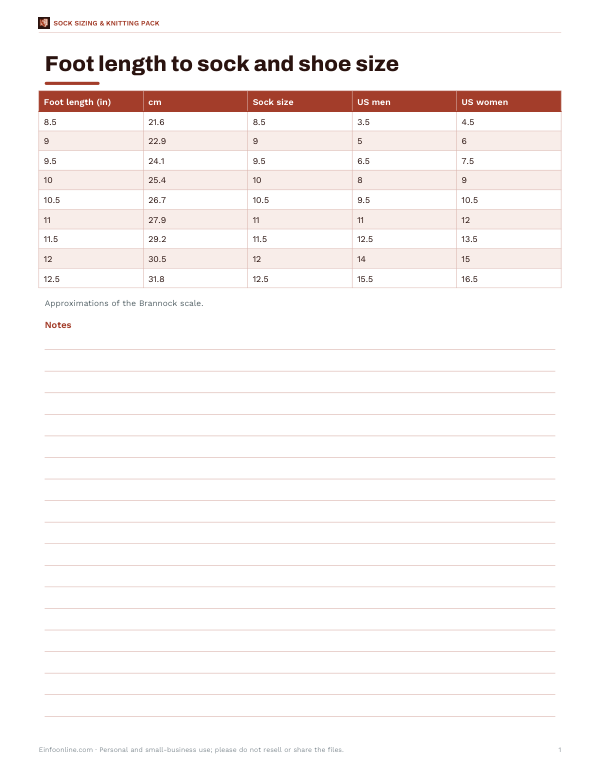
In the traditional US system, a sock size is roughly the length of the foot in inches: a size 10 sock fits a 10-inch foot. Because socks stretch, each pack covers a range, such as “sock size 10–13, fits shoe size 6–12”. Many brands now label socks by shoe size ranges or letters (S, M, L, XL) instead, which is simpler to shop but hides the underlying foot length. Measuring your foot is the most reliable way to choose.
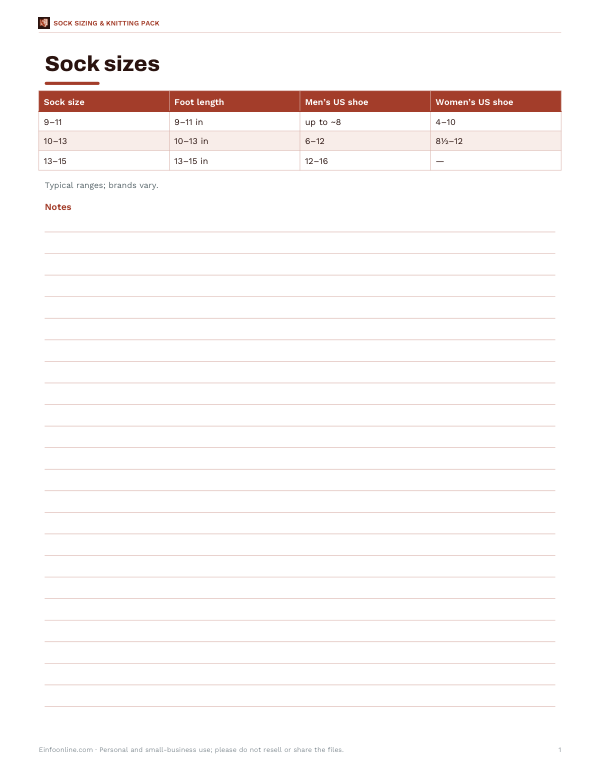
Sock size chart (typical)
| Sock size | Foot length | Men’s shoe (US) | Women’s shoe (US) |
|---|---|---|---|
| 9–11 | 9–11 in | up to about 8 | 4–10 |
| 10–13 | 10–13 in | 6–12 | 8½–12 |
| 13–15 | 13–15 in | 12–16 | — |
These are common ranges; each brand publishes its own chart. If you are at the top of a range, the next range up gives a more comfortable heel position.
Letter sizes
| Letter | Typical women’s shoe (US) | Typical men’s shoe (US) |
|---|---|---|
| S | 4–6½ | — |
| M | 7–9½ | 6–8½ |
| L | 10–12 | 9–12 |
| XL | — | 12–15 |
Letter sizes vary more between brands than numeric sizes do, especially for compression, hiking and athletic socks.
How to measure your foot
- Stand on a sheet of paper against a wall, heel touching the wall, with your weight on the foot.
- Mark the tip of your longest toe (not always the big toe).
- Measure from the wall to the mark in inches or centimetres.
- Measure both feet and use the larger.
- For knitting, also wrap a tape around the ball of the foot (the widest part) for the circumference.
Kids’ sock sizes
Children’s socks are usually sold by age or shoe size range — for example “shoe size 7–10” or “ages 3–5” — because children’s feet grow quickly. Buy socks that match the current shoe size rather than sizing up too far: loose socks bunch in shoes and cause blisters. Check fit every few months.
Hand-knit sock sizing
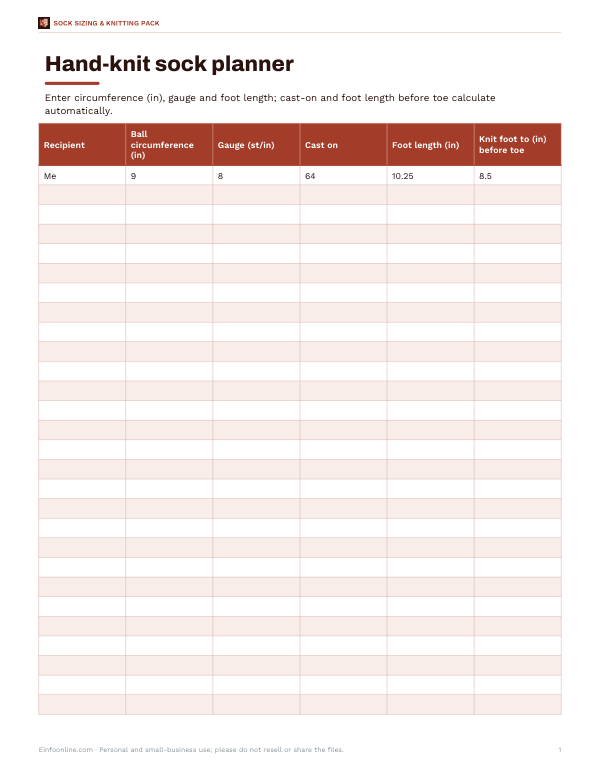
Knitted socks fit best with “negative ease” — knitted slightly smaller than the foot so they hug without sagging. A common rule is 10% smaller than the foot circumference. Multiply the circumference by 0.9 and by your gauge (stitches per inch), then round to a multiple of four so ribbing and heel shaping divide evenly. With a 9-inch foot circumference at 8 stitches per inch, that is 9 × 0.9 × 8 = 64.8 → 64 stitches. Knit the foot until it reaches about 1½–2 inches short of the total foot length before starting the toe decreases (depending on your toe shape).
Worked example
A man who wears a US size 9 shoe has a foot about 10⅓ inches long, so his sock size is about 10½. Packs labelled 10–13 fit him well. His partner, a US women’s 7, has a foot about 9⅓ inches long — sock size 9½, so she buys women’s 9–11 socks. For hand-knit socks for him, with a 9-inch ball circumference at 8 stitches per inch, the calculator suggests casting on 64 stitches.
Choosing the right sock
- Cushioned hiking socks may need a half size up if they are thick.
- Compression socks use calf circumference, not just foot size — follow the maker’s chart.
- Merino wool manages moisture and odour for sports and travel.
- Diabetic socks are non-binding at the top and seamless at the toe.
Sock heights and styles
| Style | Where it ends | Good with |
|---|---|---|
| No-show | Below the shoe line | Loafers, low sneakers |
| Ankle / low-cut | Just above the ankle bone | Trainers, running |
| Quarter / crew | Mid-calf (crew) or just above the ankle (quarter) | Everyday, hiking boots |
| Knee-high | Below the knee | Boots, dresses, compression |
| Over-the-knee | Above the knee | Fashion, warmth |
Height does not change sock size, but taller socks also need the right calf fit — especially compression socks, which are sized by ankle and calf circumference.
When socks don’t fit
Socks that are too small pull the heel pocket under your foot, wear through at the heel and toe quickly and can restrict circulation at the cuff. Socks that are too big bunch at the toe and in the shoe, causing blisters. If the heel pocket sits above your heel, size down; if it sits under your foot, size up. Wool and cotton blends with a little elastane keep their shape better than pure cotton.
Privacy
The calculator runs in your browser and stores nothing.
Frequently asked questions
What sock size is a men’s 10 shoe?
About sock size 10½; buy packs labelled 10–13.
What does sock size 9–11 mean?
Socks for feet about 9–11 inches long, typically women’s shoe sizes 4–10.
Is sock size the same as shoe size?
No. US sock sizes are based on foot length in inches.
How many stitches for knitted socks?
Foot circumference × 0.9 × gauge, rounded to a multiple of four.
Should socks be bigger or smaller than my foot?
Slightly smaller in circumference for a snug fit; the right length so the heel sits in place.
What are sock sizes in Europe?
European socks are usually labelled by shoe size ranges, such as 39–42 or 43–46.
How do I measure calf size for compression socks?
Measure the widest part of the calf, ideally in the morning before swelling, and follow the maker’s chart.
Is my data stored?
No, it runs in your browser.